YouTube automation using AI is no longer experimental. In 2026, creators are building scalable channels using structured workflows powered by AI tools. However, automation does not guarantee success. Strategy, positioning, and execution still determine results.
This guide explains how AI is used in YouTube automation, compares AI voice vs real voice, and outlines realistic monetization strategies.
What Is AI YouTube Automation?
AI YouTube automation refers to using artificial intelligence tools to handle:
- Script writing
- Thumbnail generation
- Video editing
- Voiceovers
- Research
- Analytics summaries
Instead of manually producing every part of a video, creators build repeatable systems.
Important: Automation reduces production time. It does not replace content strategy.
1. AI Script Generation for YouTube
AI tools can:
- Generate video outlines
- Expand scripts from bullet points
- Rewrite competitor content into original structure
- Optimize hooks for retention
- Add storytelling patterns
Practical Workflow
- Define niche and target audience
- Input topic + keyword intent
- Generate outline
- Refine hook manually
- Fact-check content
- Add retention triggers (open loops, pattern breaks)
Common Mistakes
- Publishing raw AI scripts without editing
- Not fact-checking statistics
- Overusing generic phrasing
- Ignoring audience psychology
AI is efficient for drafting. Human review improves engagement.
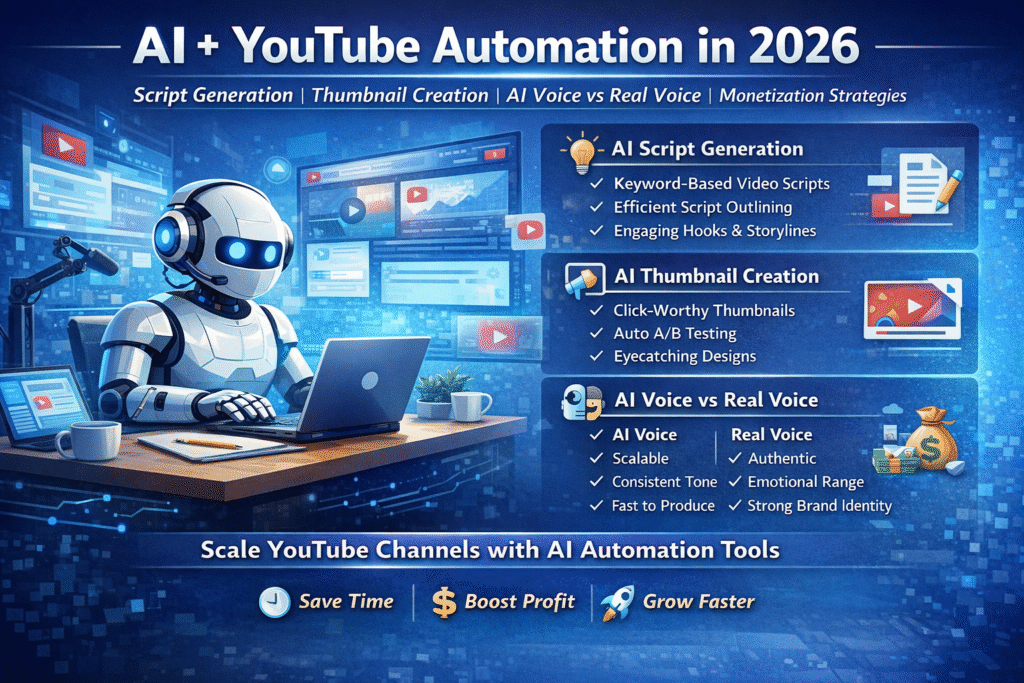
2. AI Thumbnail Creation
Thumbnails drive click-through rate (CTR). AI tools now generate:
- Custom background designs
- High-contrast text
- Emotion-enhanced faces
- Niche-specific visual templates
Key Metrics to Monitor
- CTR (Click-through rate)
- Impression growth
- A/B test performance
Automation helps generate multiple thumbnail variations quickly.
Risk: AI thumbnails that look over-designed or unrealistic reduce credibility.
Best practice: Generate multiple versions and test.
3. AI Video Editing Automation
AI editing tools can:
- Remove silences automatically
- Add captions
- Insert background music
- Cut based on engagement patterns
- Convert long videos into Shorts
Automation Use Case
Long-form video → AI extracts highlights → auto-caption → reformat for Shorts.
This multiplies content output without proportional effort.
Limitation: AI cannot always detect emotional pacing. Manual review improves quality.
4. AI Voice vs Real Voice: Direct Comparison
AI Voice
Advantages:
- Scalable
- No recording setup
- Consistent tone
- Fast production
Disadvantages:
- Limited emotional depth
- Risk of sounding robotic
- Audience trust issues in some niches
Best for:
- Faceless channels
- News summaries
- Educational explainer videos
Real Voice
Advantages:
- Authenticity
- Stronger audience trust
- Better emotional range
- Brand identity building
Disadvantages:
- Time-consuming
- Requires recording environment
- Energy consistency varies
Best for:
- Personal branding
- Opinion-based channels
- Coaching and storytelling niches
Performance Insight
Channels using real voice often have:
- Higher watch time
- Better retention in storytelling formats
- Stronger community engagement
AI voice works when the content is information-driven rather than personality-driven.
Hybrid model: AI draft → human-recorded voice → AI-enhanced editing.
5. Monetization Strategies for AI YouTube Channels
AI speeds production, but monetization depends on niche and positioning.
1. Ad Revenue (YouTube Partner Program)
Requirements:
- Watch hours + subscriber threshold
- Advertiser-friendly content
Risk:
Low CPM niches generate limited revenue even with high views.
2. Affiliate Marketing
Strategy:
- Review tools
- Tutorial videos
- Comparison content
High potential if targeting high-ticket products.
Failure path:
Low buyer-intent traffic produces minimal affiliate income.
3. Digital Products
Examples:
- Ebooks
- Courses
- Templates
- AI prompt packs
Higher margin than ad revenue.
Requires:
- Audience trust
- Clear value proposition
4. Sponsorships
Brands look for:
- Consistent upload schedule
- Niche authority
- Audience engagement
AI automation increases consistency, which improves sponsorship potential.
5. Channel Asset Building
Some creators build automated channels as digital assets and sell them.
Valuation depends on:
- Monthly profit
- Traffic stability
- Niche durability
Risk:
Algorithm dependency makes revenue volatile.
SEO Strategy for AI YouTube Automation Blog
Target keyword clusters:
- AI YouTube automation
- YouTube automation 2026
- AI voice vs real voice
- YouTube script AI tools
- Monetizing faceless YouTube channels
Content structure:
- Clear H2 and H3 headings
- FAQ section
- Balanced pros and cons
- No exaggerated income claims
Risks of AI YouTube Automation
- Saturation in low-effort niches
- Copyright violations from reused content
- AI-generated misinformation
- Over-automation leading to low retention
- Dependency on changing platform algorithms
Long-term success requires:
- Niche research
- Unique positioning
- Consistent quality
Step-by-Step AI YouTube Automation System
- Choose niche with advertiser demand
- Validate search volume
- Generate AI-assisted scripts
- Use structured thumbnail testing
- Automate editing
- Track analytics weekly
- Improve based on retention graphs
FAQ
Is AI YouTube automation profitable in 2026?
It can be profitable in strong niches, but oversaturated categories reduce returns.
Can AI voice channels get monetized?
Yes, if they follow YouTube policies and provide original value.
Is faceless YouTube sustainable?
Yes, but competition is increasing. Differentiation is necessary.
Final Assessment
AI reduces production friction. It does not guarantee growth.
Creators who combine:
- Automation efficiency
- Strategic niche selection
- Strong monetization planning
are more likely to build sustainable YouTube channels in 2026.