AI image and video generation tools are now integrated into mainstream marketing workflows. Businesses use them to produce short-form videos, generate ad creatives at scale, and test campaigns faster than traditional production methods.
However, speed does not guarantee results. Creative strategy, platform compliance, and copyright awareness determine long-term success.
This guide explains how AI image and video generation works in marketing, how to automate short-form content, how to test ad creatives with AI, and the legal risks involved.
What Is AI Image and Video Generation?
AI generation tools create:
- Marketing images
- Product mockups
- Social media visuals
- Short-form videos
- Animated explainers
- Background footage
They reduce production time and eliminate many traditional design bottlenecks.
Important: AI tools assist content production. They do not replace marketing strategy.
1. Short-Form Video Automation with AI
Short-form content (Reels, Shorts, TikTok-style videos) dominates engagement in 2026.
AI tools automate:
- Script generation
- Caption writing
- Voiceovers
- Subtitles
- Background visuals
- Auto-editing and scene cuts
Example Automation Workflow
- Input topic or product
- AI generates script
- AI voiceover added
- Stock visuals or AI-generated clips inserted
- Auto-caption formatting
- Export in vertical 9:16 format
Benefits
- Faster content production
- Lower production cost
- Easier A/B testing
- Scalable content output
Limitations
- Repetitive editing patterns
- Reduced authenticity
- Lower retention if storytelling is weak
Automation works best when paired with strong hooks and audience research.
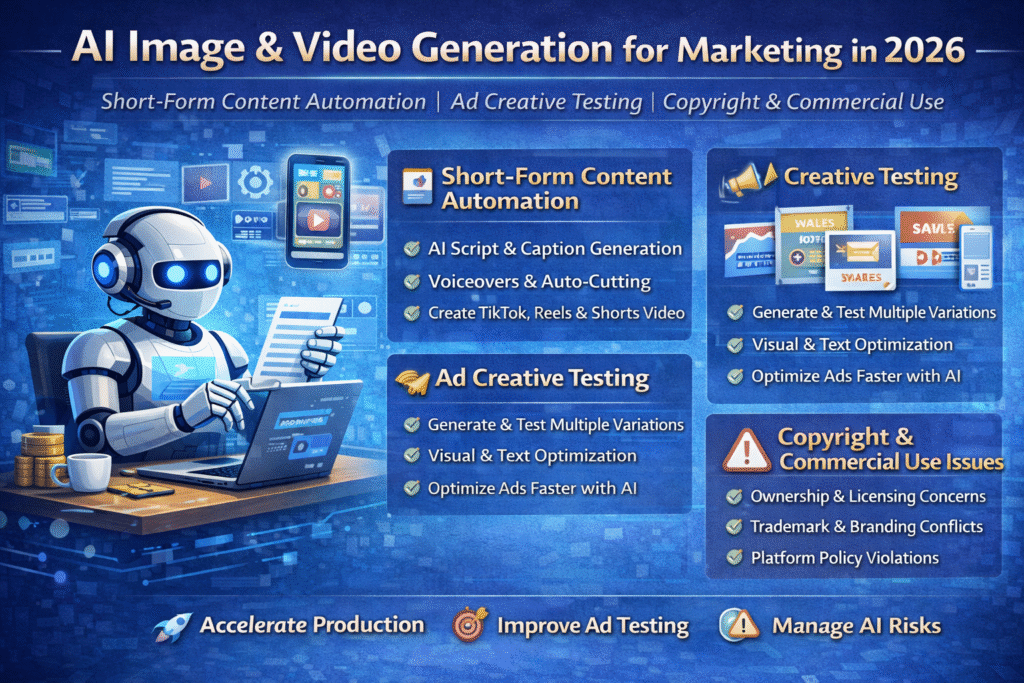
2. Ad Creative Testing with AI
Testing multiple ad creatives manually is expensive and slow.
AI helps by:
- Generating multiple image variations
- Creating headline variations
- Writing ad copy alternatives
- Predicting engagement patterns
- Analyzing campaign performance data
Practical Use Case
Instead of designing 3 ad creatives, marketers can generate 20 variations and test them simultaneously.
This increases probability of identifying high-performing creatives faster.
What AI Can Optimize
- Visual composition
- Text overlay positioning
- Color contrast
- Emotional triggers
- CTA variations
Risk
High volume does not equal high performance. Poor targeting or weak offer cannot be fixed by AI-generated visuals.
Creative testing must align with audience intent.
3. AI-Generated Product Visuals
E-commerce and local brands use AI for:
- Lifestyle product images
- Background replacement
- Mockups
- 3D-style renders
- Model-based marketing visuals
Benefits:
- Reduced photography costs
- Faster iteration
- Custom environment generation
Limitation:
Over-polished or unrealistic visuals may reduce customer trust.
4. Copyright and Commercial Use Issues
This is the most overlooked risk area.
AI-generated content raises questions about:
- Ownership rights
- Training data sources
- Brand likeness issues
- Trademark conflicts
- Platform policies
Key Considerations
- Check tool commercial license terms.
- Avoid generating copyrighted characters or branded elements.
- Review platform advertising guidelines.
- Avoid replicating identifiable real individuals.
- Understand jurisdiction-specific intellectual property laws.
Major mistake:
Assuming all AI-generated content is automatically safe for commercial use.
Legal responsibility usually falls on the publisher.
SEO Benefits of AI Marketing Content
When used properly, AI-generated marketing content can:
- Increase publishing frequency
- Improve testing speed
- Enhance creative diversity
- Support faster campaign optimization
However, search engines and ad platforms prioritize:
- Originality
- Authentic engagement
- Value-driven content
Mass low-quality AI content can harm performance.
Cost Comparison: Traditional vs AI Production
Traditional Production
- Videographer fees
- Studio costs
- Editing software
- Graphic designer fees
- Longer turnaround time
AI Production
- Subscription fees
- Faster turnaround
- Lower marginal cost per asset
- Requires oversight
AI is cost-efficient for testing and high-volume campaigns but may not replace premium brand campaigns.
Risks and Limitations of AI in Marketing
- Oversaturation of similar AI-generated styles.
- Reduced brand uniqueness.
- Potential compliance violations.
- Audience fatigue from repetitive formats.
- Dependence on automation without strategic oversight.
Strong marketing still requires positioning, differentiation, and audience research.
Best Practices for Using AI in Marketing
- Use AI for rapid testing, not final brand identity.
- Combine AI visuals with real customer testimonials.
- Regularly audit content for originality.
- Track engagement metrics, not just production speed.
- Stay updated with copyright policies.
Hybrid model performs best: AI for scale, human strategy for positioning.
FAQ
Can AI-generated videos be monetized?
Yes, if they comply with platform guidelines and provide original value.
Is AI content copyright-free?
Not automatically. Licensing terms vary by platform.
Does AI improve ad performance automatically?
No. It increases testing capacity but does not replace strategic targeting.
Final Analysis
AI image and video generation reduces creative production costs and accelerates marketing experiments. It enables faster short-form content creation and large-scale ad testing.
However, misuse leads to generic branding, compliance risks, and diminishing engagement.
Long-term success depends on combining AI efficiency with structured marketing strategy and legal awarenes.