Artificial intelligence is evolving beyond simple chatbots and tools. In 2026, AI agents are becoming practical systems that help small businesses automate workflows, reduce manual work, and improve efficiency without large teams.
This guide explains what AI agents are, how they work, practical use cases, realistic ROI expectations, and how small businesses can implement them safely.
What Are AI Agents?
AI agents are intelligent software systems designed to complete multi-step tasks with minimal human involvement.
Unlike basic automation tools that follow fixed rules, AI agents can:
- Understand goals instead of single commands
- Plan and execute workflows
- Analyze data and make decisions within defined limits
- Integrate with email, CRM, websites, and messaging platforms
Example:
Traditional automation:
- Send email when form is submitted.
AI agent workflow:
- Receive lead → analyze intent → research company → qualify lead → draft personalized email → update CRM automatically.
Why AI Agents Are Important for Small Businesses
Small businesses often struggle with:
- Limited staff resources
- Repetitive administrative tasks
- Slow customer response times
- High outsourcing costs
AI agents address these problems by handling repetitive cognitive work.
Key benefits:
- Reduced operational workload
- Faster customer response
- Improved lead follow-up speed
- Scalability without increasing payroll
However, AI agents require monitoring and proper setup. They are productivity tools, not complete replacements for human decision-making.
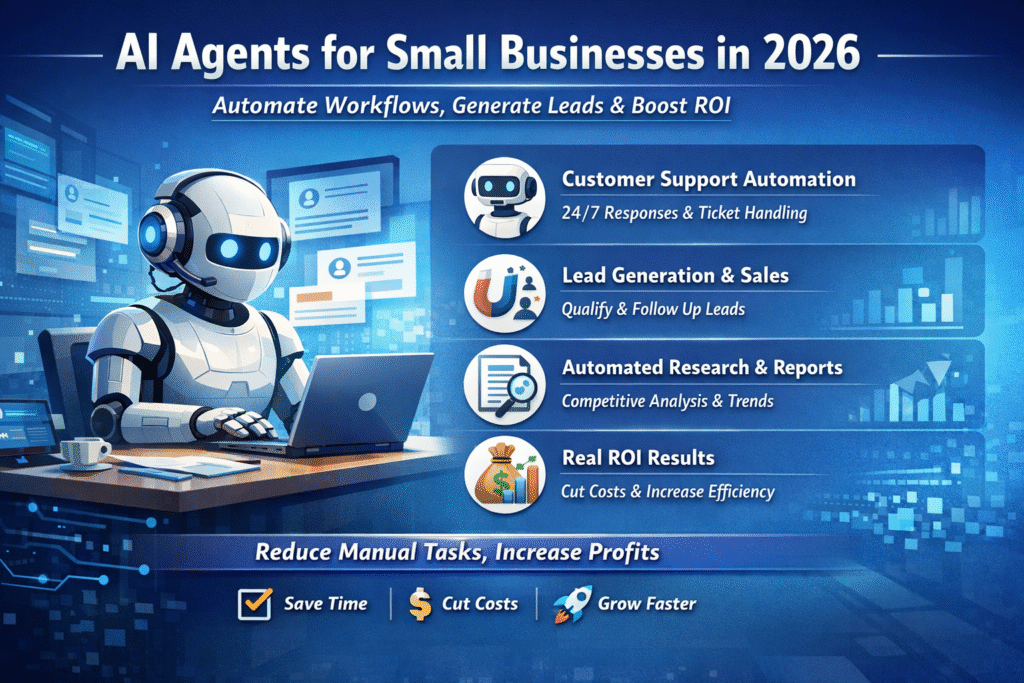
Top AI Agent Use Cases for Small Businesses
1. Customer Support Automation
AI agents can manage common customer queries by:
- Answering frequently asked questions
- Providing order or service information
- Creating support tickets automatically
- Escalating complex issues to humans
Benefits:
- 24/7 availability
- Reduced support backlog
- Faster response times
Potential risks:
- Incorrect answers if knowledge base is incomplete
- Poor customer experience if responses are not reviewed regularly.
2. Lead Generation and Sales Automation
AI agents help businesses respond quickly to potential customers.
Capabilities include:
- Analyzing incoming leads
- Scoring lead quality
- Researching prospects online
- Drafting personalized outreach messages
Why this matters:
Lead response speed significantly affects conversion rates. Automation ensures no inquiry is ignored.
3. Research and Market Monitoring
Instead of manual research, AI agents can:
- Monitor competitor pricing
- Track industry trends
- Summarize news updates
- Analyze customer feedback
Result:
Daily summaries reduce research time while improving decision-making.
4. Marketing Workflow Automation
AI agents assist with:
- Content ideation
- Social media scheduling
- Ad performance summaries
- Email follow-up sequences
Limitations:
AI-generated marketing content still requires human review to maintain brand consistency.
Real Business Examples
Local Service Provider
Workflow:
Customer message → AI answers common questions → collects booking details → updates calendar.
Outcome:
Reduced phone handling and faster scheduling.
Online Course Creator
Workflow:
Customer inquiry → AI agent sends FAQ answers → shares course links → tags interested prospects.
Outcome:
Improved response time without hiring additional staff.
Small E-commerce Business
Workflow:
Customer support chatbot → automated product recommendations → follow-up emails.
Outcome:
Higher engagement and reduced manual support effort.
ROI Breakdown: Costs vs Benefits
Typical investment:
- Monthly subscription for AI tools
- Initial setup time
- Ongoing monitoring
Potential gains:
- Reduced manual workload (20–60%)
- Lower outsourcing expenses
- Faster lead conversion
Common mistake:
Expecting instant automation without workflow planning. Start with one process and scale gradually.
Choosing AI Agent Tools
When selecting tools, evaluate:
- Integration with existing software
- Data privacy controls
- Custom workflow flexibility
- Transparent pricing structure
Avoid tools that promise full automation without configuration or training.
Risks and Limitations of AI Agents
Before implementing, understand:
- AI can produce incorrect information.
- Over-automation can reduce personalization.
- Data privacy risks require proper handling.
- Usage-based pricing may increase costs unexpectedly.
Best practice:
Use AI agents for structured and repetitive workflows first.
Step-by-Step Guide to Getting Started
- Identify repetitive tasks consuming time.
- Document the workflow clearly.
- Choose one automation use case.
- Train the AI using real business data.
- Monitor performance closely.
- Expand automation after validation.
Future of AI Agents for Small Businesses
AI agents are likely to become core infrastructure for small businesses. Instead of replacing teams entirely, they will assist with repetitive work, allowing businesses to operate efficiently with fewer manual processes.
Businesses that adopt structured automation early may gain operational advantages over competitors relying solely on manual workflows.
Frequently Asked Questions (FAQ)
Are AI agents expensive for small businesses?
Many platforms offer scalable pricing, allowing small businesses to start with basic workflows before expanding.
Do AI agents replace employees?
AI agents automate repetitive tasks but still require human supervision and decision-making.
Is coding required to use AI agents?
Many modern platforms provide no-code or low-code solutions suitable for non-technical users.
Are AI agents safe for customer data?
Safety depends on platform security and proper configuration. Always review privacy policies and data handling practices.
SEO Notes for AdSense Approval Structure
- Informational, educational tone without exaggerated claims
- Clear headings (H2/H3) for readability
- Balanced discussion of benefits and risks
- FAQ section improves search visibility
- Avoid excessive affiliate or promotional language
If required, I can also provide:
- Exact keyword list + search intent clusters for ranking
- Meta title, meta description, and slug
- Internal linking strategy for your site structure
- AdSense approval checklist tailored to this article.