Revenue cycle management (RCM) is one of the most expensive and error-prone operational areas in healthcare. Administrative work such as insurance verification, coding, claims submission, and payment processing consumes significant staff time and introduces delays that impact cash flow.
AI-driven administrative automation is changing how hospitals and clinics manage billing workflows. By using machine learning to automate repetitive processes, healthcare organizations reduce errors, accelerate reimbursements, and improve operational efficiency.
This SEO-optimized guide explains how AI works in revenue cycle management, key platforms, benefits, risks, and implementation considerations.
What Is AI Revenue Cycle Management (RCM)?
Revenue cycle management covers the entire financial workflow from patient registration to final payment collection.
Core Processes
- Insurance eligibility verification
- Medical coding (ICD, CPT codes)
- Claims generation and submission
- Denial management
- Payment posting
- Revenue analytics
AI systems analyze historical billing data and workflow patterns to automate or assist these processes.
How AI Improves Administrative Workflows
Traditional billing relies heavily on manual data entry and rule-based software. AI introduces:
Intelligent Automation
- Auto-population of billing codes from clinical notes
- Detection of missing documentation
- Claim error prediction before submission
Workflow Optimization
- Automated task prioritization
- Routing claims to appropriate departments
- Identifying revenue leakage
Predictive Analytics in Billing
- Forecasting claim approval probability
- Detecting patterns causing denials
- Suggesting corrective actions
Key Platforms in AI Revenue Cycle Automation
Olive AI
Olive AI focuses on administrative automation for healthcare organizations.
Key capabilities:
- Automates repetitive back-office tasks
- Integrates with EHR and billing systems
- Reduces manual workload in claims processing
Operational value:
- Faster processing time
- Reduced administrative cost
- Lower human error rate
Risk:
Automation without oversight can propagate incorrect data across multiple systems.
AKASA
AKASA uses AI-driven medical billing automation focused on coding accuracy and workflow efficiency.
Key features:
- Automated coding suggestions
- Real-time claim validation
- Denial management assistance
Use cases:
- Improving clean claim rate
- Reducing revenue cycle delays
- Supporting compliance workflows
Limitation:
Requires high-quality structured data and consistent workflow integration.
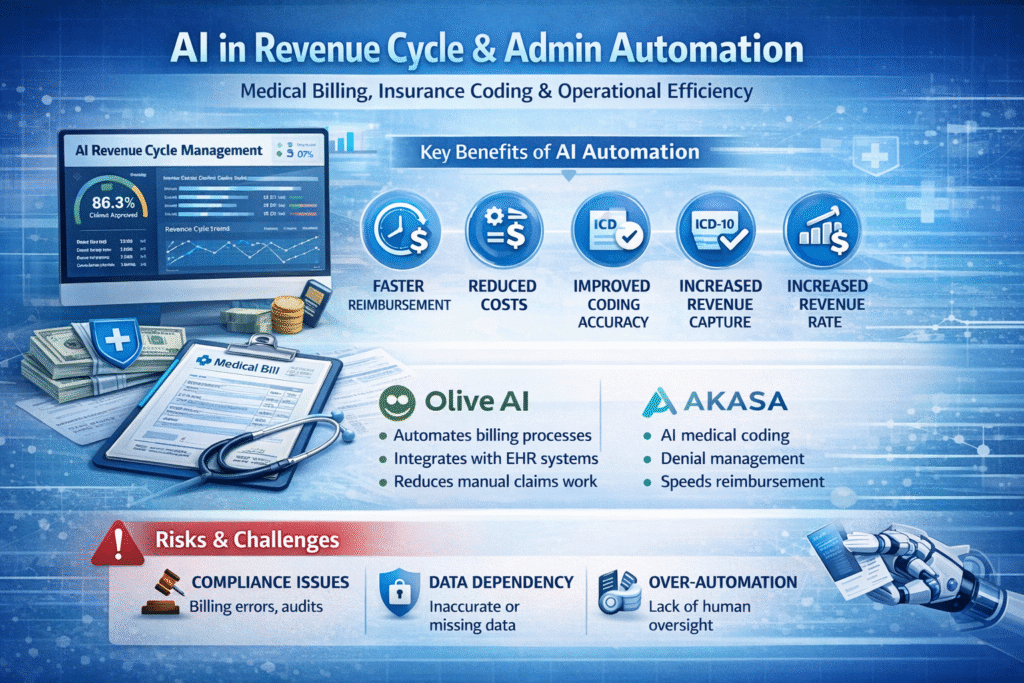
Benefits of AI in Healthcare Administration
Faster Reimbursement Cycles
Automated claim processing reduces billing delays.
Reduced Operational Costs
Less reliance on manual administrative labor.
Improved Coding Accuracy
AI identifies inconsistencies and missing documentation.
Increased Revenue Capture
Detection of under-coded or missed billable services.
Risks and Operational Challenges
Data Dependency
AI accuracy depends heavily on data quality and proper documentation.
Compliance Risk
Incorrect automation can lead to billing errors or regulatory issues.
Staff Resistance
Workflow changes may face internal resistance if not properly managed.
Over-Automation
Fully automated billing without review increases financial risk.
Implementation Best Practices
- Maintain human oversight for coding decisions.
- Validate AI outputs against historical billing performance.
- Monitor denial rates after deployment.
- Start with partial automation instead of full replacement.
Organizations that attempt full automation immediately often face integration issues.
Conclusion
AI-driven revenue cycle automation is transforming healthcare administration by reducing manual work and improving financial performance. Platforms like Olive AI and AKASA demonstrate how intelligent automation can streamline coding, billing, and claims workflows.
However, the main risk lies in over-automation without monitoring. Successful deployment requires human oversight, accurate data, and integration into existing workflows rather than replacing them entirely.