Healthcare delivery is shifting from hospital-centric to patient-centric models. AI-powered chatbots, automated triage systems, and remote monitoring tools are reducing friction between patients and providers. The objective is simple: faster access, lower cost, and scalable care delivery.
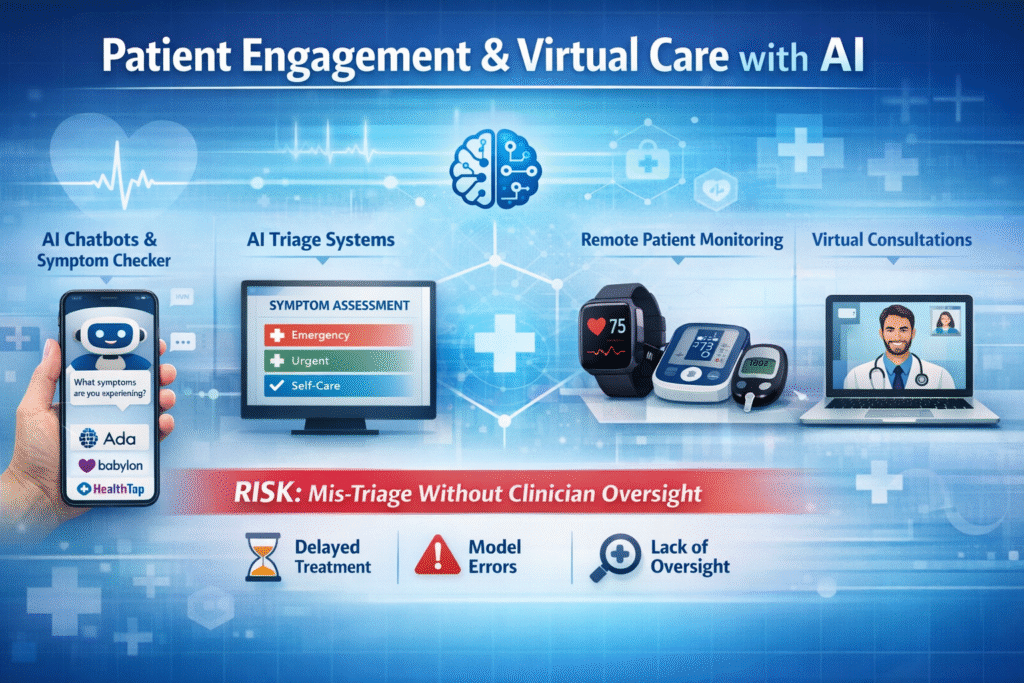
This article analyzes how patient engagement and virtual care systems work, key platforms in the space, benefits, operational impact, and the major risks—especially mis-triage.
1. AI Chatbots in Healthcare
AI chatbots act as the first interaction layer between patient and provider.
Core Functions
- Symptom collection
- Basic medical guidance
- Appointment scheduling
- Medication reminders
- Follow-up engagement
Example Platforms
- Ada Health – AI-based symptom checker that evaluates user inputs and suggests possible conditions.
- Babylon Health – Virtual consultation platform combining AI triage with doctor access.
- HealthTap – AI-assisted telemedicine with doctor Q&A and virtual visits.
Operational Impact
- Reduces call center load
- Filters low-risk cases
- Improves appointment conversion
- Collects structured patient data before consultation
Weakness: Accuracy depends on user input quality. Garbage input → unreliable output.
2. AI-Powered Triage Systems
Triage AI classifies patient urgency before clinician review.
How It Works
- Patient enters symptoms.
- NLP models interpret free-text inputs.
- Risk scoring algorithm categorizes urgency:
- Emergency
- Urgent
- Routine
- Self-care
Benefits
- Shorter waiting times
- Prioritized emergency handling
- Reduced ER overload
- Scalable intake during peak demand
Failure Points
- Edge cases not represented in training data
- Rare conditions misclassified
- Over-reliance without clinician validation
High-risk scenario: A cardiac symptom misclassified as indigestion. That is liability exposure.
3. Remote Patient Monitoring (RPM)
Remote monitoring collects real-time physiological data outside hospitals.
Common Devices
- Smart blood pressure monitors
- Glucose monitors
- Wearables (heart rate, ECG)
- Pulse oximeters
What It Enables
- Chronic disease tracking
- Early warning alerts
- Reduced hospital readmissions
- Continuous data-driven care
Business Model Impact
Hospitals reduce inpatient costs. Providers bill for RPM services. Insurance reimbursement increasingly supports it.
Limitation: Data overload. Without structured alert systems, clinicians experience fatigue.
4. Virtual Consultations & AI-Assisted Telemedicine
Virtual care platforms integrate:
- AI pre-consult screening
- Automated documentation
- Video consultation
- Post-visit engagement
Efficiency Gains
- Reduced no-shows
- Shorter consultation time
- Automated medical note generation
- Lower operational cost per patient
However, AI does not replace clinical judgment. It augments workflow.
5. Key Benefits of AI-Driven Patient Engagement
1. 24/7 Accessibility
Patients can interact anytime without physical visit.
2. Cost Reduction
Lower administrative overhead and triage costs.
3. Data Standardization
Structured symptom collection improves diagnostic workflow.
4. Scalability
One AI system handles thousands of interactions simultaneously.
6. Major Risks and Limitations
Mis-Triage Risk (Critical)
If AI categorizes a serious condition as low-risk, delayed treatment can occur.
Risk factors:
- Incomplete symptom input
- Model bias
- Lack of clinician oversight
- Overconfidence in automation
Mitigation:
- Human-in-the-loop validation
- Clear emergency disclaimers
- Continuous model retraining
- Conservative risk thresholds
Data Privacy Concerns
Healthcare data is high-value. Breaches create legal and financial damage.
Regulatory Compliance
Different countries have varying telehealth and AI medical device regulations. Non-compliance can halt operations.
7. Strategic Reality Check
AI patient engagement systems are operational tools, not independent medical authorities.
They:
- Improve efficiency
- Reduce costs
- Scale intake
They do not:
- Replace physicians
- Guarantee diagnostic accuracy
- Eliminate liability
Hospitals deploying AI without clinical governance increase risk exposure.
Conclusion
Patient engagement and virtual care powered by AI are reshaping healthcare delivery. Platforms like Ada Health, Babylon Health, and HealthTap demonstrate how automated triage, chatbots, and remote monitoring can increase accessibility and operational efficiency.
However, the primary failure path is mis-triage without clinician oversight. Organizations that combine AI automation with structured human review achieve better outcomes and lower risk.
AI in virtual care is leverage—not autonomy.