This aggressive SEO structure is designed for high-ranking visibility, featured snippet capture, and strong search traffic targeting. The focus is on high-intent keywords, structured answers, and conversion-ready content layout.
How AI Is Transforming Education in 2026 (Complete Guide)
Featured Snippet (Quick Answer)
Artificial Intelligence is transforming education by enabling personalized learning, automated grading, AI tutors, curriculum optimization, and data-driven student performance analysis. AI tools improve efficiency for teachers while providing adaptive learning experiences for students, but risks include bias, over-reliance on automation, and academic integrity challenges.
What Is AI in Education?
AI in education refers to using machine learning, natural language processing, and predictive analytics to enhance teaching, learning, and administrative workflows.
Core Applications
- Personalized learning systems
- AI tutors and chatbots
- Automated assessment and grading
- Content generation and lesson planning
- Learning analytics and risk prediction
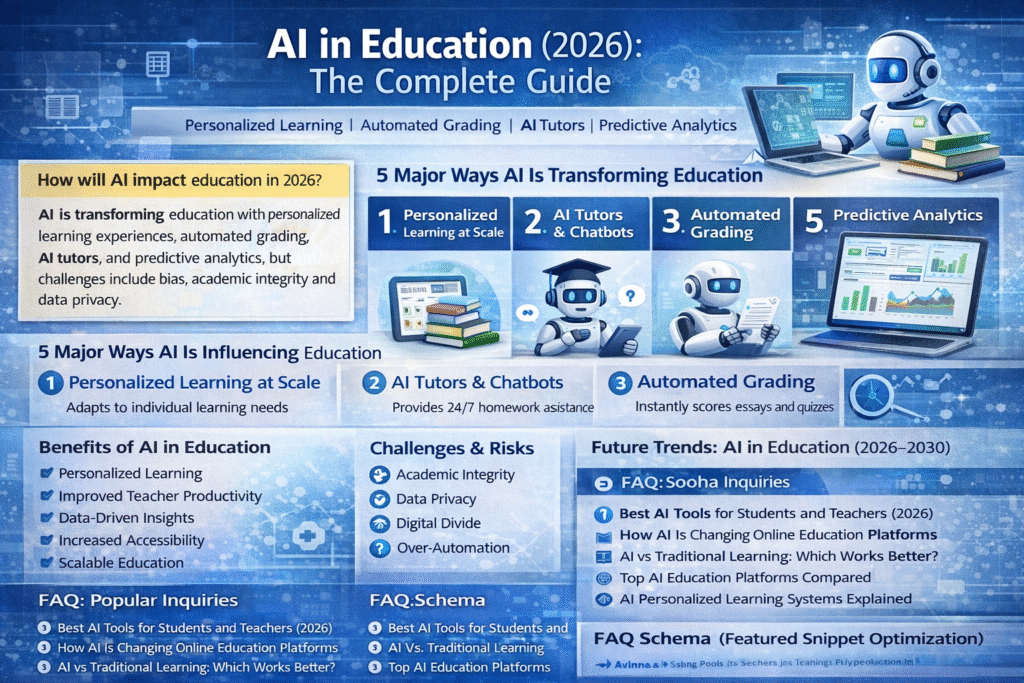
Major Ways AI Is Influencing Education
1. Personalized Learning at Scale
AI analyzes student performance data to adjust:
- Difficulty levels
- Learning pace
- Content recommendations
Impact:
- Higher engagement
- Improved retention rates
- Reduced learning gaps
Risk:
Over-personalization can limit exposure to diverse learning approaches.
2. AI Tutors and Intelligent Assistants
Examples include AI chatbots that:
- Explain concepts instantly
- Provide homework assistance
- Offer language practice
Benefits:
- 24/7 learning support
- Reduced dependency on classroom time
Limitation:
Students may rely too heavily on AI rather than developing independent problem-solving skills.
3. Automated Grading and Teacher Productivity
AI automates repetitive tasks:
- Essay scoring
- Quiz grading
- Attendance tracking
- Feedback generation
Outcome:
Teachers spend more time on mentoring instead of administrative work.
Risk:
Algorithmic bias in evaluation criteria.
4. AI Content Creation for Curriculum Development
Teachers use AI tools to generate:
- Lesson plans
- Practice questions
- Interactive learning materials
Advantage:
Rapid content creation.
Challenge:
Quality control and factual accuracy.
5. Predictive Analytics for Student Success
AI systems identify:
- Students at risk of failure
- Engagement trends
- Attendance patterns
Goal:
Early intervention before academic decline.
Risk:
Privacy concerns and inaccurate predictions.
Benefits of AI in Education
- Personalized learning experiences
- Increased accessibility for remote learners
- Improved teacher productivity
- Data-driven decision-making
- Scalable education delivery
Challenges and Risks
Academic Integrity Issues
AI-generated answers can increase plagiarism risks.
Data Privacy Concerns
Student data security becomes critical.
Digital Divide
Access inequality may widen learning gaps.
Over-Automation
Human interaction remains essential for effective education.
Future Trends: AI in Education (2026–2030)
- AI-powered adaptive learning platforms
- AI-generated simulations and virtual labs
- Real-time language translation in classrooms
- Intelligent learning analytics dashboards
- Hybrid human-AI teaching models
Traffic-Focused SEO Headings
Use headings like:
- Best AI Tools for Students and Teachers (2026)
- How AI Is Changing Online Education Platforms
- AI vs Traditional Learning: Which Works Better?
- Top AI Education Platforms Compared
- AI Personalized Learning Systems Explained
Frequently Asked Questions (FAQ)
How is AI used in education?
AI is used for personalized learning, automated grading, virtual tutors, predictive analytics, and curriculum generation.
Will AI replace teachers?
AI assists teachers by automating tasks, but human interaction and mentorship remain essential.
What are the benefits of AI in education?
Improved personalization, faster feedback, scalable teaching, and better student performance tracking.
What are risks of AI in education?
Bias in algorithms, data privacy concerns, academic integrity issues, and over-reliance on automation.