Running a small business in 2026 is more challenging due to rising costs, competition, and the need for faster operations. AI automation is becoming a practical solution for small business owners who want to reduce expenses and improve efficiency without hiring additional staff. Instead of relying on manual work, AI allows businesses to automate repetitive tasks, analyze data quickly, and make better decisions based on real insights.
AI automation in small businesses refers to the use of artificial intelligence tools to handle tasks such as customer support, marketing, data analysis, and daily operations. These systems are designed to work continuously with minimal human intervention. Unlike traditional software, AI tools can learn from data and improve performance over time, making them more effective as usage increases.
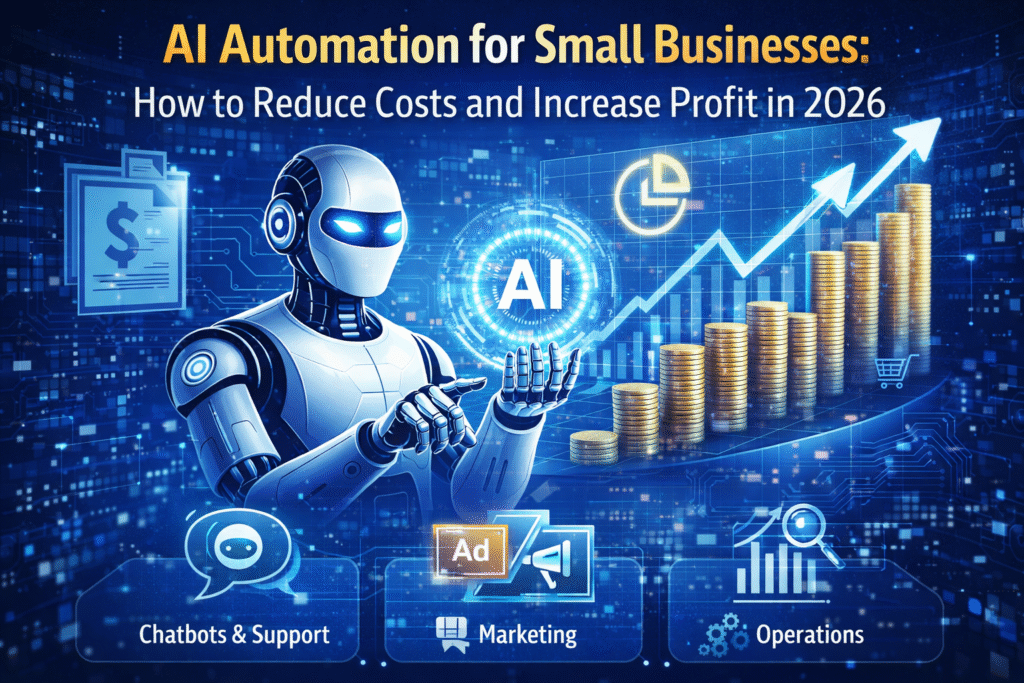
One of the main areas where AI helps reduce costs is customer support. Small businesses often struggle with handling customer queries due to limited staff. AI-powered chatbots can answer common questions instantly, manage basic support requests, and operate 24/7. This reduces the need for hiring additional support staff while improving response time and customer experience.
Marketing is another area where AI automation delivers measurable results. AI tools can generate content, suggest ad strategies, and analyze campaign performance. Instead of spending hours creating posts or running trial-and-error ad campaigns, businesses can use AI to identify what works based on data. This reduces wasted marketing spend and improves return on investment.
AI also improves operational efficiency by automating routine processes such as data entry, reporting, and inventory tracking. These tasks are time-consuming and prone to human error. AI systems can handle them faster and with higher accuracy, allowing business owners to focus on growth and strategy rather than daily operations.
Choosing the right AI tools is critical for success. Content generation tools can help with blogs, social media posts, and product descriptions. Chatbot tools can handle customer interactions, while analytics tools provide insights into business performance. However, using too many tools without a clear plan can increase costs instead of reducing them. The focus should be on solving specific problems, not adopting technology blindly.
Implementing AI automation should be done step by step. The first step is to identify repetitive tasks that consume time and resources. The next step is to select one or two tools that address those tasks effectively. Starting small reduces risk and allows you to measure results before expanding. Tracking performance is important to ensure that the tools are actually improving efficiency and not creating additional complexity.
The results of AI automation are not instant but can be significant over time. Many small businesses report cost reductions between 20% and 40% when automation is implemented correctly. Time savings are often even more noticeable, as tasks that previously took hours can be completed in minutes. However, these results depend on proper execution and consistent use.
There are also risks associated with AI automation that should not be ignored. Using the wrong tools can lead to unnecessary expenses without clear benefits. Over-automation can reduce the quality of customer interaction, especially if human oversight is removed completely. Data privacy is another concern, as AI systems often require access to sensitive business information.
From an SEO perspective, AI automation for small businesses is a high-demand topic with strong search intent. Business owners actively look for ways to reduce costs and improve efficiency. Creating content around practical use cases, step-by-step guides, and real-world results increases visibility and trust. Targeting specific keywords such as “AI tools for small business” or “how to automate business tasks” can improve search rankings.
In conclusion, AI automation is a practical tool for small businesses aiming to reduce costs and increase profit in 2026. The key advantage lies in using AI strategically to solve real problems rather than adopting it as a trend. Businesses that focus on efficiency, data-driven decisions, and gradual implementation are more likely to achieve sustainable results.